I was twelve years old when The Naked Chef first aired on BBC1 in 1999. I don’t recall watching it. But it must have been in the ether; I remember thinking it was wild that there was a guy going about cooking with no clothes on. I had a lot of questions, like, did he wear an apron or…?
Little did twelve year old me know how much of my future career would be taken up thinking, talking, and now writing, about Jamie Oliver (and calling him out for being anti-fat).
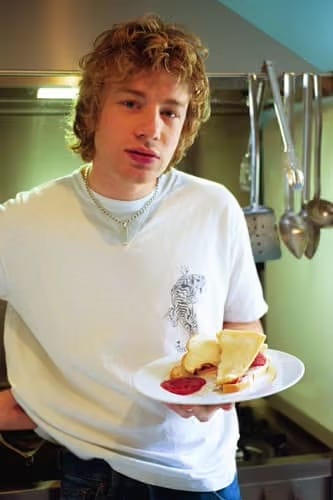
The ‘naked’ part of The Naked Chef referred, of course, to Oliver’s 'stripped-back’ cooking style. ‘It’s gotta be simple, it’s gotta be tasty, it’s gotta be fun’, Oliver tells us in the opening sequence while reclining on his couch. Unlike the haughty machismo of his elders – Gordon Ramsay, Marco Pierre White – Oliver rejected ‘posh’ food and adopted an everyman persona replete with a put on Cockney accent - ‘mockney’. He wanted us to make fish pie, or chili con carne, or a jacket potato, but do it ‘really well’. Where we were meant to be a little afraid of the old guard, Oliver was aspirational. The show and accompanying books not only wanted us to cook like Oliver (with an earnest nonchalance), but to be like Oliver (or be with someone like Oliver).
Martin Godwin // The Guardian
The Naked Chef was as much about the vibes as it was about the food. Shots of cooking are interspersed with Oliver riding through London on his Vespa, shopping for ingredients in Soho, Islington, and Notting Hill while red London buses drive past in the background. Oliver was in his early 20s when the series was shot and he embodied the youthful mood of turn-of-century Britain: Britpop, Mod culture, and Big New Labour Energy. It was easy, it was fun, it was Ladcore. This is in stark contrast to Oliver’s contemporaries at the time; notably Eton educated Hugh Fearnley-Whittingstall was undertaking experiments in rural homesteading (and single-handedly trying to make pear wine happen) in his series River Cottage.
Oliver cultivated this Ladcore persona further through catchphrases like ‘pukka’ and ‘wicked’. Instead of fine-dining dishes, he made ‘non-poncey’ food and instructed the audience to ‘bash’, ‘smash’, and ‘throw’ ingredients into the pan. He can be seen sliding down the banister of his flat while clad in the painfully trendy Duffer of St George (alongside the likes of David Beckham and Noel Gallacher).
Ladcore gave Oliver a means to differentiate and distance himself from the restaurant chef, sure. But it also prevented him from being subsumed into the role of ‘home cook’ – a feminised space occupied by the figure of The Mother or The Grandmother. Female home cooks are matronly; hardened. They are concerned with budgets, shopping lists, economising freezer space, making a little go further. They are not sliding down the banister or reclining on the couch. At the same time, they are required to be warm and nurturing; they must deliver love and care for their children through the medium of food. And if they don’t meet these exacting standards, they will be put on trial and subject to public scrutiny. This of course foreshadows Oliver’s ‘fat old scrubbers’ comment, but we’re getting ahead of ourselves.
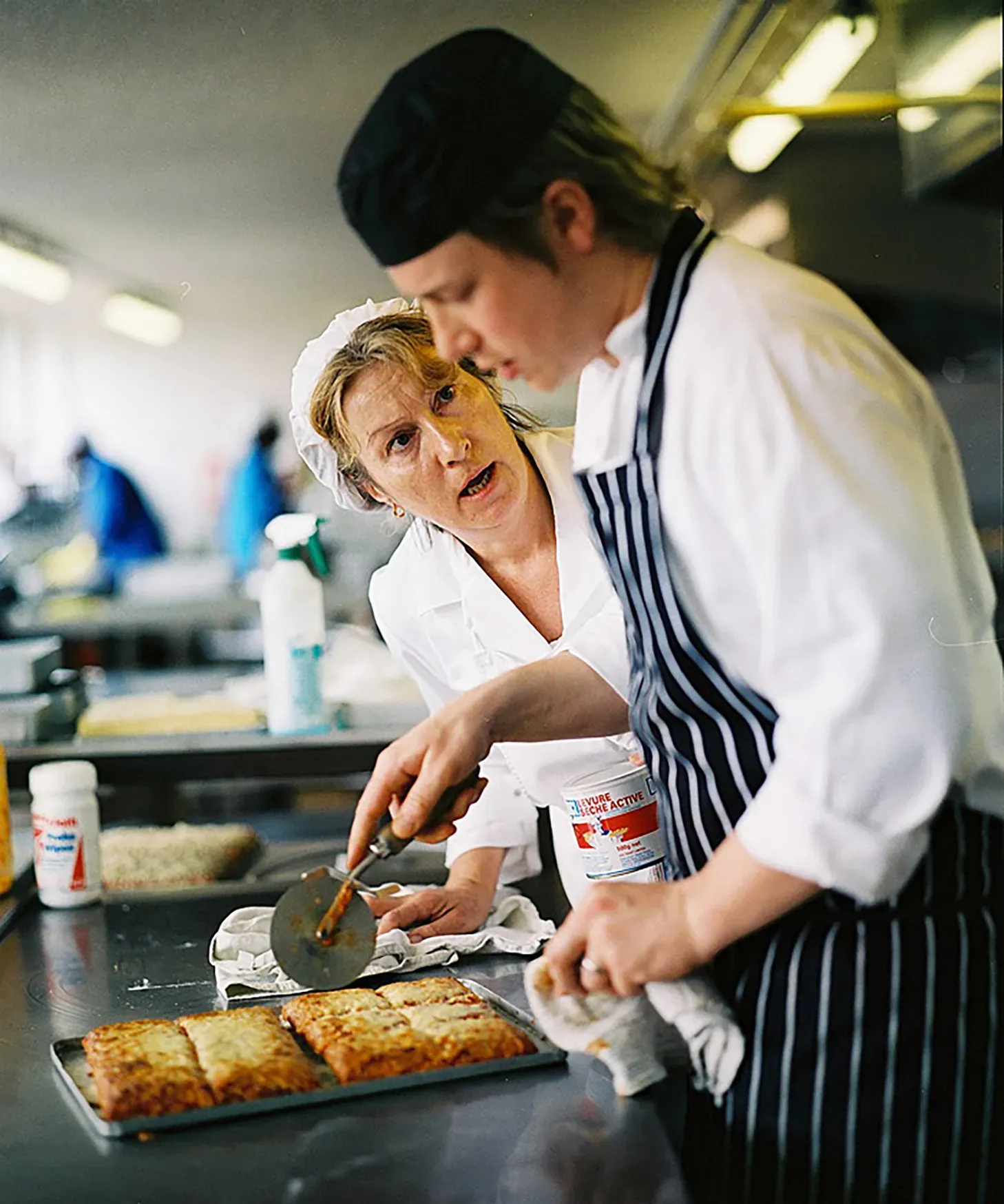
Jamie's School Dinners, Image: Channel 4
This post is free to read
Enter your email address to read this post and our library of free posts.