Hey and welcome back to CIHAS! We took a short pause over the summer but are back to regular programming (at least until a child gets sick or a school closes due to a freak weather event 🫠 - my money's on a flash flood).
First up, we have a new instalment in the CIHAS interview series. Today I'm talking to Emma Hopkins from Mothers Manifesto about food insecurity and poverty more broadly.
This interview comes at what I think is – for want of a better term – a really weird moment. Both culturally and politically, but also specifically within the nutrition establishment. We have, on the one hand, a deeply divisive conversation about ultra-processed foods, where both the 'UPF is good' and 'UPF is bad' camps are missing the point entirely (more on that later this month). Simultaneously, the UK government is expected to release guidance that advise we all keep small reserves of food and water on-hand for emergencies. In practice, this means processed, if not ultra-processed food.
Similarly, the government is also expected to release new school food standards guidance to update existing frameworks. Based on what I saw in the consultation documents, these are relatively minor tweaks (plus installing nutrition cops in schools). We'll cover these when they are released, but I have a sense that these marginal tweaks will result in diminishing returns, nutritionally speaking. Especially as pilot testing suggested the food is gross and kids didn't eat it. We can have meticulous nutrition standards, but it's only nutrition after it is eaten. Again, we are missing the point.
To their credit, Labour have extended universal free school meals to anyone receiving universal credit. But, as Emma points out, this still misses out a lot of kids. As with the UPF debate, fucking around with school food standards misses the point.
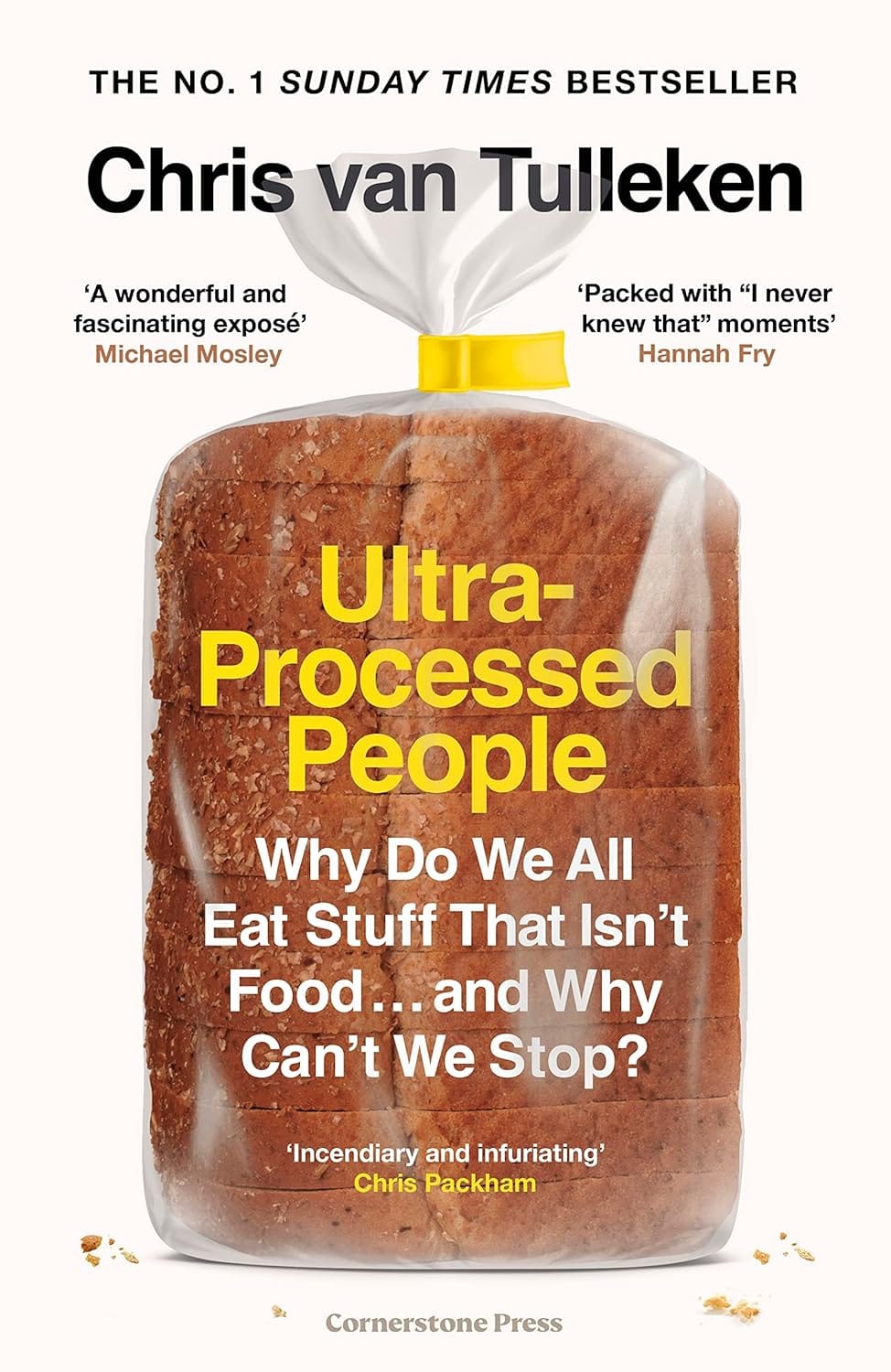
This is exactly why I wanted to talk to Emma; Mothers Manifesto are an organisation that seem to be able to see through the bullshit and get to the marrow of the problem. While Chris van Tulleken is fretting about how his daughters £5.65 pint of Hackney Gelato doesn't melt properly, a staggering number of children in this country don't have enough to eat. While we are banning puddings in schools, single mothers are forfeiting eating in order to be able to feed their kids.
Of course, it doesn't have to be a binary thing. We should be critical of the food system. We should have robust nutrition standards in schools. But when I see the Bold Bean Co lady (and her £3.25 jar of beans) lobby for beans in schools instead of universal free school meals, I know we have gone so far off the rails that we start thinking the train is a car. The train is a train and 1-in-5 parents don't have enough food to feed their children.
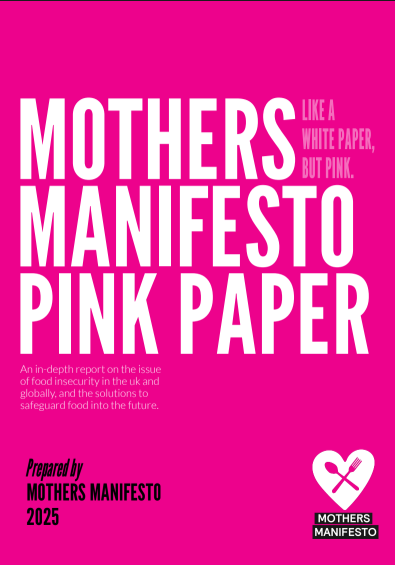
So yeah, things are weird. Which is why I appreciate Mothers Manifesto's clear-eyed demands (as set out in their brilliant Pink Paper). Unlike more nutrition-focussed organisations, they see the gnarly, knotted connections between hunger, poverty, climate catastrophe, and the hoarding of indecent amounts of wealth.
I hope you enjoy this interview with Emma and let me know in the comments if you have any other questions for her (or have a great idea for who we should speak to next!).
Laura: Can you start by telling us a bit about you and the work you are doing with Mothers Manifesto? I’d like to hear more about the hunger strike actions you take on a regular basis outside of Parliament (and nationally). What are you hoping this brings attention to?
Emma:Hi Laura, thank you so much for inviting me here and giving Mothers Manifesto and our campaign a platform. I am a mother of four beautiful boys as well as a herbalist, and have spent many years campaigning and working towards the implementation of positive solutions around both environmental and social justice issues.
Mothers Manifesto is a collective of mothers and supporters (all genders welcome) who have come together through care and determination to call for positive change. We are campaigning for every child to have enough food and the basic essentials to thrive in life, something we believe is ultimately achievable with the right policies in place.
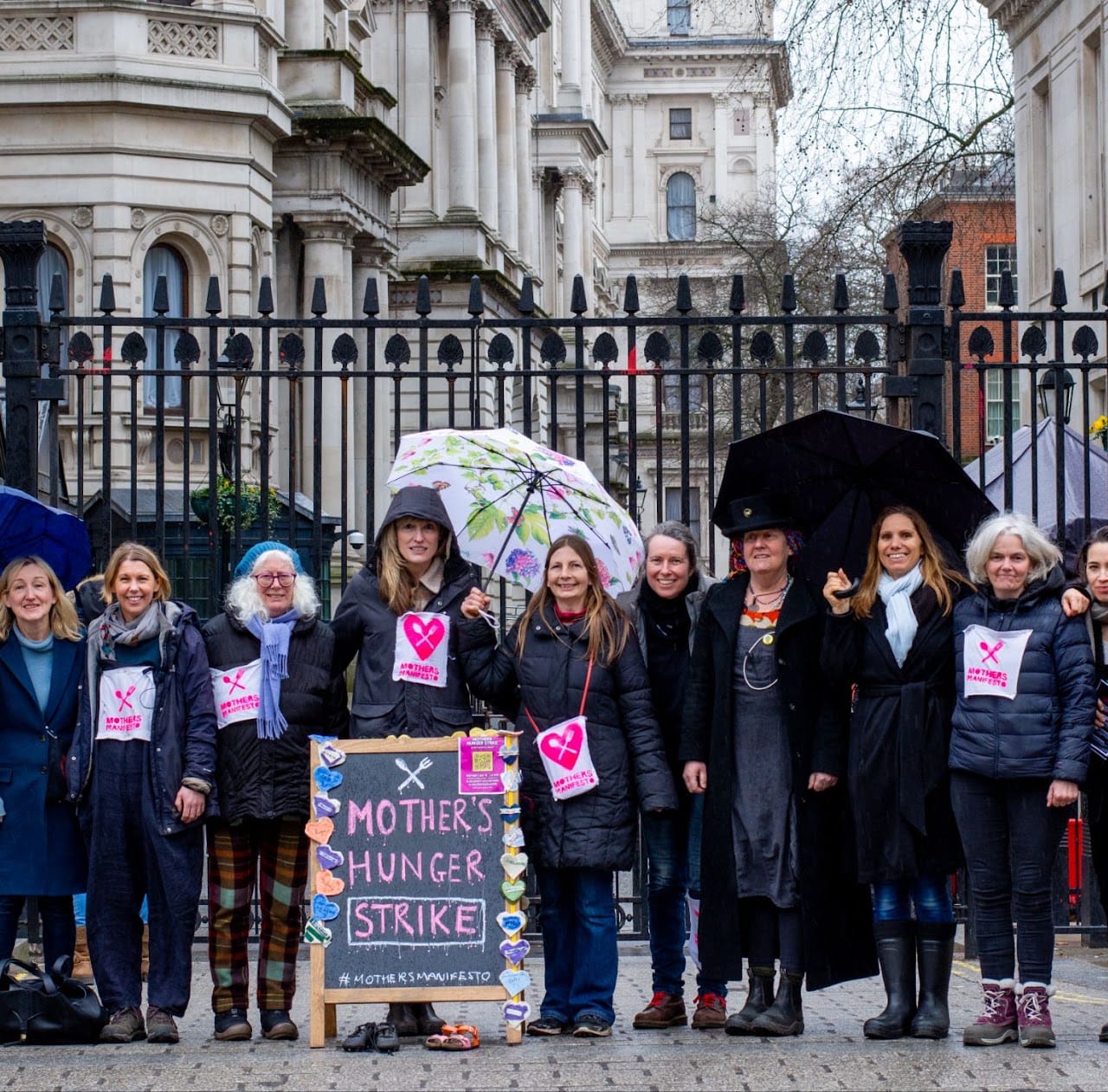
We started our campaign on Mothers Day 2023 by holding a six-day Mothers Hunger Strike outside Parliament to call for a number of practical and achievable solutions to address the various issues driving hunger, both here in the UK and globally. Our hope was, through our symbolic action, to highlight the lived reality of so many children and their families who are going hungry, a chronic issue for far too many.
We have found the strikes to be incredibly effective in helping us to engage with people, both those passing by, and in London also MPs, civil servants and members of other organisations heading into Parliament. We've had such incredible support, including one MP offering to store our stuff in his offices within Parliament! Amazing!
Since our first strike in 2023, we've held annual strikes outside Parliament as well as one- day regional strikes across the county. We've also had a number of meetings in Parliament, with cross party support, as well as significant media coverage on radio, TV and in the papers, all of which has really helped to amplify what we are hoping to achieve.
The current reality is heartbreaking, with mums regularly skipping meals themselves in order to feed their kids, as well as struggling to buy even the very basic essentials, such as rent, heating or clothes for their children.
A staggering one-in-seven families here in the UK are struggling to put food on the table, rising to one in three for single-parent families, 90% of which are headed by women. This is totally unnecessary and a shame on this country, one of the richest in the world. Families with children are in fact the group most at risk of living in low-income households.
Food banks are providing an absolute lifeline for many families, but we know that they are also struggling with capacity and rising need. With food banks nearly doubling in the last five years, this is a sign of the amazing care within our communities, but it is also a sign of a broken social security system. People should not need to rely on food banks to feed their families.
The instinct to protect and to nourish our children is universal, and yet for too many families the barriers to achieving this are simply out of reach. Globally, of course, children aren't just hungry, many are starving. I cannot imagine how utterly devastating it is to lose your child from something which is so preventable as a lack of food, and yet 45% of all children's deaths under 5 are due to a lack of nutrition.
The world produces enough food for everyone on the planet. This is not an issue of a lack of abundance but of equity and distribution. Every child, indeed every human, has the basic right of enough food to eat and the essential needed in life to thrive.
Hunger is not an inevitability but driven by politicalchoice and we are determined as mothers to do all we can to bring about more caring and just policies and to bring about a world where every child has enough to eat and the basic essentials to thrive.
Laura: Mothers Manifesto’s Pink Paper is a comprehensive manifesto which sets out key demands to the government to end food insecurity. Can you walk us through some of the key demands around benefit reforms, environmental justice, and wealth taxes, and maybe speak to how these things are linked?
Emma: We produced The Pink Paper towards the end of last year and as you say it sets out a number of practical and achievable measures to start to address food insecurity in the UK and globally as well as safeguarding our food into the future. Many organisations have endorsed the paper, from Save the Children and the National Education Union to Oxfam and War on Want. We have also heard from various MPs to say they have been using the paper in their work in Parliament, which we were overjoyed to hear. The paper is really accessible and I definitely encourage your readers to take a look. You can find The Pink Paper on our website.
Given the recent heatwaves, droughts and wildfires across the UK, Europe and other parts of the world, many will be seeing the link between these impacts and the food we eat. Many crops have been severely reduced or even lost altogether. When there is a reduced harvest and availability of produce, the price of food goes up. Something which will affect those already struggling to put food on the table both here in the UK and globally.
In order to address food insecurity we must address the growing issues of inequality but we also need radical, bold and systemic action to address other drivers of hunger including the climate and nature crisis.
In The Pink Paper, our manifesto, we have put forward a number of solutions, from ensuring that social security provides enough for families to afford the essentials and providing nutritious Universal Free School Meals in state schools, to investing in a resilient and sustainable food system, supporting farmers to transition to nature-friendly agriculture and tackling extreme wealth inequality. We also need to keep our promise on foreign aid by recommitting to 0.7% of GNI and meet our climate commitments by rapidly decarbonising across all sectors, while using our influence internationally to address the global drivers of hunger, including conflict, climate change and debt.
Laura: In your Pink Paper you write: ‘Hunger is not inevitable. It is the result of political and economic decisions, and it can be ended if different choices are made, choices that put children’s rights, social equity, and resilience first.’ There’s a strong narrative among the popular press that hunger is a result of poor planning or ineffective budgeting, and that we just need to make food cheaper. Can you explain why it’s more complex than that and how political will could end hunger? What would that look like in practice?
Emma: We can of course do things differently, we have so many of the answers to the issues we are facing. We also know that extraordinary change is possible when governments align around a commitment to save and improve lives, and when policies are based on care, compassion, resilience and a willingness to act.
We saw this at the end of the Second World War, when large parts of our country lay in ruins, with high levels of poverty and destitution and the country economically broken by the war. From that unpromising foundation the Welfare State was imagined and implemented, creating the National Health Service, council house building programme and a social security to support the population. We also saw this more recently during Covid, when governments acted with urgency and ambition to respond to an unprecedented international health emergency. When governments decide something is a priority, then extraordinary change is absolutely possible.
Hunger is not an inevitability, rather it is the result of a particular set of political decisions. If we implement different policies we would get a very different outcome, one which could include a world where no child goes hungry. The Millennium Goals, between 1990 and 2014, resulted in world hunger being halved, an extraordinary achievement that shows what is possible.
The rise in hunger in the UK is not about poor planning or ineffective budgeting; for many families, including working families, there simply isn't enough money coming in to cover the basics. The cost-of-living crisis has hit at a time when, for so many people, there is no slack in their household budgets. Many of those using food banks are in employment, including teachers and nurses and still they are struggling to make ends meet.
As a society we understand many of the issues driving hunger, and we also have the resources to address them. This is not fundamentally a problem of scarcity. Rather it is about access, distribution and political choices about how resources are shared.
The narrative that blames the poorest for their circumstance is deeply pernicious and particularly damaging because it shifts responsibility away from the systems and policies that continue to perpetuate poverty. We live in an economy which concentrates money towards the wealthiest in society, and where extreme wealth is allowed to flourish at the expense of society at large. In 2024 the collective wealth of the UK’s 57 billionaires increased by £35 million a day, meanwhile we are hearing the most heartbreaking stories of mums skipping meals to feed their children, supermarkets locking up baby milk powder formula as people are stealing it and children turning up to school with empty lunch boxes.
It is possible to have a more equal, resilient and caring society, this is not beyond our reach. We need the political will and courage to implement the solutions that put children's wellbeing and their future at the heart of decision making.