For a while now, I’ve been thinking and writing about foodwork. Many of you have joined in on community threads that have looked at this from various different angles. We all agree that foodwork is a lot. Too much, in fact. But we struggle to imagine alternatives. What follows is my attempt to define the problem, contextualising it historically, socially, and politically. And offering some suggestions for what life could look and feel like if we dared to really challenge ourselves to conceptualise foodwork differently. Dare I say, socially and communally? Here I’m looking at how the Family Dinner is used to further a deeply conservative ideology, the role that nutritionists and dietitians play in upholding this ideology (🤡), and a Marxist-Feminist analysis of what the fuck we can do about it.
I submit that we need to abolish the Family Dinner.
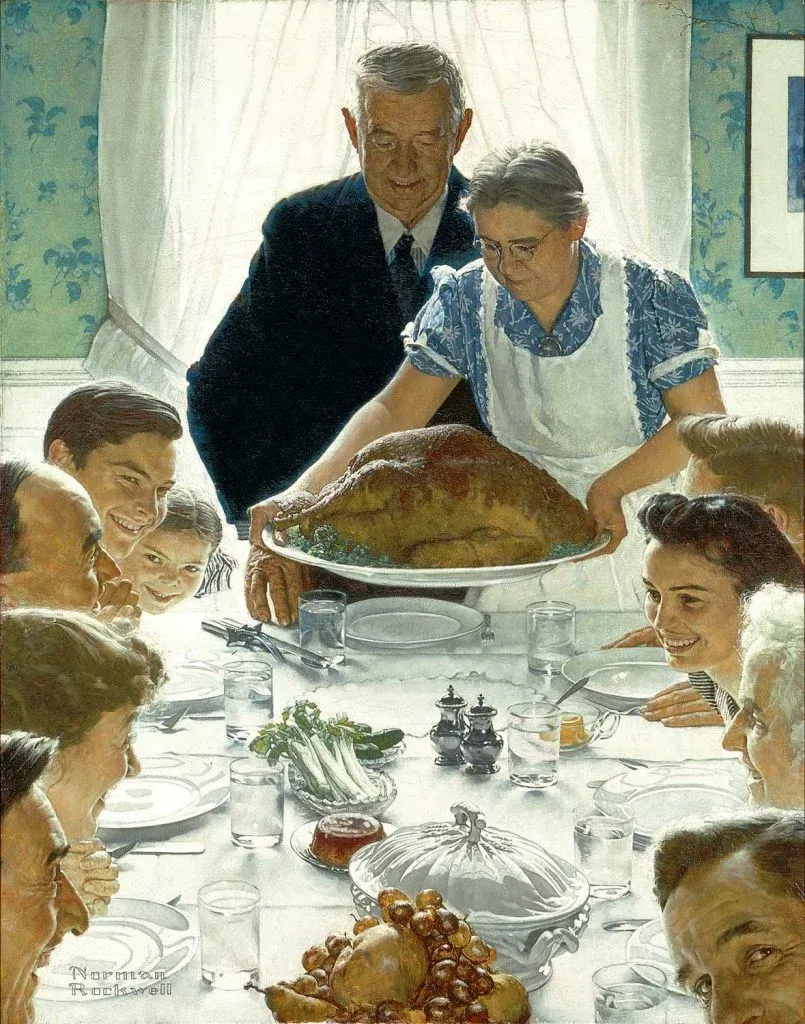
Norman Rockwell, Freedom from Want (1943). Norman Rockwell Museum Collections
When you think of family dinner, what image comes to mind?
I don’t think Norman Rockwell was a bad guy, but he did us dirty with Freedom from Want, his 1941 portrayal of an American Thanksgiving dinner. In the painting, based on Rockwell’s family and friends, everyone is sat round with delighted, borderline smug expressions on their faces; expectant bellies, ready to be stuffed like the turkey the painting’s matriarch is proudly presenting to the group. This painting has set the bar for our expectations of what a family dinner should look like; warm, inviting, convivial, abundant. Search for stock photos of family dinner and you can see the traces of Rockwell’s vision: smiley faces sitting patiently, lovingly gazing at each other, a bounty of food on the table.
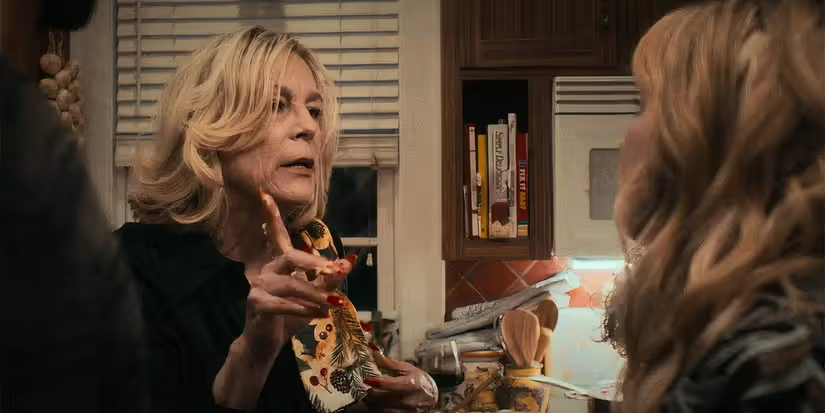
Contrast that with one of the most tense and volatile family dinners in TV history. The sixth episode of season two of The Bear, entitled Fishes. It stars Jamie Lee Curtis as Donna Berzatto – Carmy, Sugar, and Michael’s alcoholic mother – as she prepares a Feast of The Seven Fishes for Christmas Eve. In the kitchen there are egg timers buzzing maniacally every 30 seconds; red sauce smeared all over the countertop and microwave; people yelling over each other and at one point Donna slops sandwich filling on bread with her bare hands. Donna just wants a nice family Christmas. Instead, everything unravels. When Sugar asks her mum ‘are you ok?’, this is how she replies:
‘Do I not look OK Natalie? Did I not bust my ass all day for you motherfuckers? This is fucking beautiful! Am I OK? AM I OK?? Are you fucking assholes OK? YOU DIDN’T DO SHIT. This is fucking gorgeous. FUCK YOU!’
She ends her soliloquy by smashing a bunch of plates on the floor.
Then, she does what I imagine a lot of mothers have fantasised about doing after making dinner for a houseful of ingrates; she plows her car straight into the side of the house.
Most of us have probably experienced an explosive family dinner like that, plus or minus a car going through the wall. Stressful, raised voices, fighting. An exhausted and under appreciated matriarch. Ungrateful kids whining, refusing to eat what has been prepared for them. Men making themselves a cocktail and pretending things aren’t burning, literally and figuratively.
Even when it’s not a high stakes event like Christmas or Thanksgiving, the chances are that family dinners lean more chaotic than a Norman Rockwell painting. And that’s for those of us where family dinners are not a source of abject terror or violence. So why does this image of the perfect family dinner endure? Why is it considered aspirational to sit down and eat together, as a family?
Part of the reason is that family dinner has great PR.
Family dinner can get kids to eat more vegetables and prevent eating disorders and stop kids from getting fat. Family dinner can promote harmony, and unity, and stop kids bickering. Family dinner puts an end to underage sex and illicit drug use and vaping and getting addicted to phones.
There’s virtually no problem that can’t be solved by sitting down and eating dinner together. Or, so it goes.
In certain nutrition-y circles, family dinner is considered hallowed. The ideal container for all of those made-from-scratch Mediterranean-inspired meals you’re rustling up. Carlos Montiero, the Brazilian science guy who coined the term ultra-processed food (UPF), laments how ready-made foods have debased the sanctity of the family meal, making it more likely that kids and teens will - gasp - eat food alone in their rooms in front of screens. Truly dystopian. Anyway, from my mid-divorce vantage point, UPFs are saving any notion of a ‘family dinner’ I’m having with my five-year-old. But go off Carlos, my guy.
Veg Power, an alliance ‘dedicated to improving children’s diets’ and empowering ‘parents to make healthy eating simple’, recently published a report called Making more of family mealtimes. In it, they state ‘if we are to improve how the country eats, family mealtimes must be a priority focus’, even though their own research found that children who eat the most family meals in a week eat the same amount of vegetables as kids who eat the least family meals in any given week. The report concludes by saying ‘we’re placing such weight on the positivity people feel towards family meals and their absolute determination to preserve – or ideally increase – mealtime harmony. By tapping into that positive sentiment, while mitigating the threat of disruption, we’re confident we can unlock interest and action. Focusing on the end-benefit of more harmonious mealtimes is therefore our first priority.’ Right.
How do they plan on doing this? Well, if they’re going to cut-through to ‘families’ that in practice only means one thing; mothers. It means infiltrating places mums hang out and look for advice and information. So, they’re collaborating with Netmums – a parenting website targeted at mothers with 3 million monthly users. They’ve also recruited dietitian and nutritionist influencer mums to show us how it’s done.
This post is for subscribers only
Sign up now to read the post and get access to the full library of posts for subscribers only.